
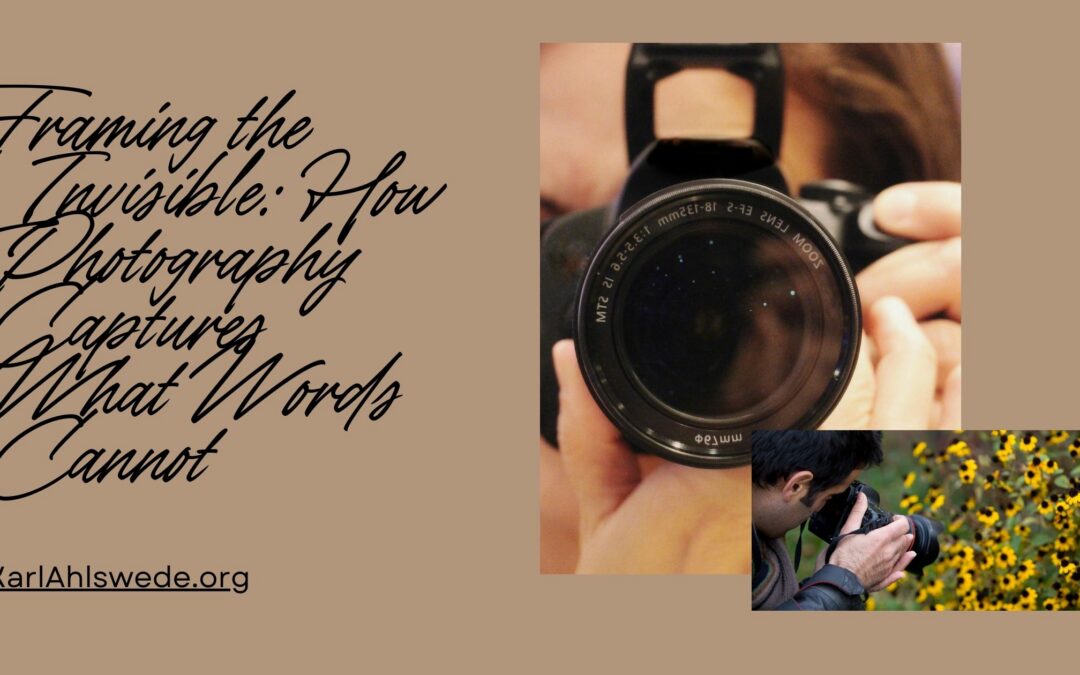
In a world flooded with content, photography remains one of the most powerful forms of storytelling. A single image can communicate emotion, context, tension, hope, and history in a fraction of a second. Long before someone reads a caption or a headline, they feel a photograph.
Photography is not just about documenting what’s visible — it’s about framing what’s invisible.
The best photographers understand that they are not simply capturing light. They are capturing energy, movement, intention, and the subtle details that most people overlook.
Photography as Emotional Architecture
At its core, photography is about emotion. A portrait can reveal vulnerability. A cityscape can communicate ambition. A candid street shot can tell the story of an entire neighborhood.
Light, shadow, composition, and perspective all work together like architectural elements. Just as a building is designed to guide movement and feeling, a photograph is composed to guide the viewer’s eye and emotional response.
Consider how lighting transforms a subject. Soft, natural light can create intimacy and warmth. Harsh directional light can create drama and tension. Golden hour casts nostalgia. Blue hour invites reflection.
None of these elements happen by accident.
Seeing Beyond the Surface
Great photographers train themselves to see what others miss. They notice how reflections in a window double a narrative. They observe the way lines in a building draw the eye upward. They recognize fleeting expressions that last less than a second.
Photography sharpens awareness.
You begin to notice textures in brick walls, the rhythm of repeating patterns, the contrast between old and new architecture, the quiet human interactions happening in the background. The camera becomes less of a device and more of a lens into perception itself.
In cities especially, photography becomes a study of contrasts — motion and stillness, wealth and struggle, tradition and innovation. Each frame can hold layers of meaning.
Storytelling Without Explanation
The most compelling images leave room for interpretation. They invite the viewer to step into the story.
A child running through an open park. A business owner standing in the doorway of their storefront. A construction crane towering against a sunset skyline. These scenes are not just visual — they are symbolic.
Photography doesn’t tell people what to think. It gives them space to feel.
That’s what makes it powerful across industries. In real estate, for example, photography doesn’t just showcase square footage — it sells possibility. In branding, it communicates identity before a single word is read. In philanthropy, it humanizes impact in a way statistics never could.
An image builds connection instantly.
The Balance Between Art and Precision
Photography lives at the intersection of creativity and technical mastery. Understanding aperture, shutter speed, ISO, and focal length provides control. But vision provides meaning.
A technically perfect image without emotion feels empty. An emotionally powerful image with slight imperfections often feels authentic and alive.
The craft requires patience. Waiting for the right light. Adjusting angles. Observing movement. Anticipating moments before they unfold.
Sometimes the best photographs are planned meticulously. Other times, they appear unexpectedly — a spontaneous laugh, an unscripted glance, a sudden shift in weather.
The magic lies in being ready for both.
Photography in the Digital Era
Today, everyone carries a camera in their pocket. Billions of images are uploaded daily. Yet the abundance of photographs has not diminished the value of great photography — it has elevated it.
Because when everything is documented, intention stands out.
Professional photography is less about access and more about perspective. It’s about knowing what to exclude as much as what to include. Framing is an act of decision-making. What remains outside the image matters as much as what remains inside it.
In an age of constant scrolling, strong imagery stops attention.
Capturing Legacy
Photography also serves as preservation. It freezes moments that will never happen again. Neighborhoods change. Skylines evolve. Families grow. Businesses expand. Communities transform.
Photographs become visual history.
Years later, an image can transport someone back to a specific place, feeling, or chapter of life. That is not just documentation — it is legacy.
The Responsibility of the Lens
With the power to shape perception comes responsibility. Photographers influence how people, places, and stories are represented. Authenticity matters. Context matters. Respect matters.
The lens can elevate truth — or distort it.
The most impactful photographers approach their work with curiosity and integrity. They seek to understand before they capture.
More Than a Picture
Photography is not about pressing a button. It is about observing deeply, composing intentionally, and feeling fully.
It captures what words struggle to articulate — the tension before a handshake, the pride in a completed project, the quiet resilience of a community.
It frames the invisible.
And when done well, it reminds us not just to look — but to truly see.